
Parental Grief Pilgrimages
An autoethnography about grief and bereavement facilitated through transformational travel
I just finished the summer semester of my first two elective classes, Outdoor Ecotherapy and Integration of Pilgrimage Sacred Journeys in Therapy. They were brilliantly powerful for the season of life I am in, as both a student and a human. The last eight weeks coincided with the final preparation leading up to my Dad’s Celebration of Life. The celebration was last weekend, and I am still recharging from the marathon of energetic output the last few months have been for me. For this piece, I would like to share some of what I have learned about Pilgrimage as it applies to my own healing journey.
I spent the last eight weeks immersed in learning about religious and secular pilgrimages, or sacred journeys. Until about 100 years ago, pilgrimage was defined purely as a religious devotional journey to a sacred site specific to an individual's religion. But with the Industrial Revolution came a cultural focus shift in North America and Europe to the exploration of the self beyond religious constructs. This culture shift contributed to the secularization of pilgrimage journeys. While pilgrimage can absolutely be intertwined with a religious or spiritual journey, it can also be about initiation into a new chapter of existence, bridging the liminal space between one season of life and the next. I have experienced transformational travel in this way, connected to the deaths of my parents.
Below is an autoethnographic piece I wrote on my transformational travel pilgrimages during the death and bereavement process surrounding my parents’ deaths over the last five years. I feel strongly that wisdom forms from integrated personal experience. This is my process to integrate how my lived experiences around death and spirituality have supported my healing process. My hope is that, in reading what I have learned, you will be supported in your own healing journey to explore and integrate similar or different practices for your own integration process. I have learned through a season of great loss that grief can not be integrated alone. I hope you have a wonderful community of supportive beings who are there to hold you during your grief, but if you do not, know you are not alone. I see your shadow and light, pain and joy, laughter and sorrow; it’s all welcome here.
Gone, Now What?: Pilgrimage One
This is an autobiographical recounting of two solo road trips I took from the American Southwest back to Washington state. These trips are deeply interconnected with each other and the grief process following the death of my parents. I hadn’t planned it, but these trips served purposes on physical, emotional, mental, and spiritual levels to help me move through my grieving process.
The first trip took place in the summer of 2022, to bring my mom’s car from my parents’ home in Southern California back up to Washington, where I live. This trip marked the one-year anniversary of my mother’s death. It feels too complicated to put in words what the year leading up to this trip was like emotionally, so I will boil it down to simply grief-ridden and very painful.
Planning this trip, I felt intuitively drawn to drive through the Southwest, specifically the national parks in Arizona and Utah. This area holds a special memory for me, as I visited it with my parents both as a child and as an adult. I planned my route from my parents’ house in Southern California to Sedona, Arizona, to drive my mom’s car first.
In Sedona, I spent a very special week on a retreat with members of my spiritual yoga community. During this week, I hiked the Vortexes, visited the Chapel of the Holy Cross, wrote, and felt a deep spiritual connection to my mom, experiencing the beauty and majesty of the Red Rocks with me. I then continued on my own, driving to the South Rim of the Grand Canyon. I camped, slept under the stars, hiked, skydived, wrote, cried, read, and continued to feel my mom’s presence in a way I hadn’t up until this point of my grief journey.
My last night at the South Rim of the Grand Canyon. I sat out on the edge of the Canyon, watching the hues of pink and orange in the sky melt into the setting sun. I felt called to listen to music, so I opened up Spotify and clicked on a random playlist. The first song to play was Landslide by Fleetwood Mac. This was my mom and my song. I wept, staring out into the clouds with tear-blurred eyes. An opening came through the pink hues of cumulonimbus clouds, and light poured down from this opening. As the music played, song after song felt curated to my mom’s favorite music. A wave of grief engulfed me. Missing my mom so much, I looked a mile down to the base of the grandest canyon on our continent and thought, “What would it be like to fall down off this edge? To slip and wake up in the place where she is?”
In this moment, the light in the clouds intensified, the melodies of my mom’s favorite songs poured into my ears, and I felt her laughter. My mom’s laughter reverberated through the air, and I heard her whisper to me, “You can’t come here... not yet. There’s much for you to do still. You must stay.”
To this point in time, following my mom’s death, I had not had her communicate with me in this way. My surprise was reflexively overtaken, like a petulant child, as I felt myself grow enraged, as if being told ‘no’ to something I wanted deeply. This feeling subsided, and a warmth of understanding came over me. The warmth felt like her hug, and I melted into it like an exhausted toddler after a tantrum. I felt my wandering soul’s exhaustion from holding this confusion of where she had gone and why I could not go there.
It’s unexplainable in the physical dimensions of logic, but after that moment, I felt a peace in my grief that I knew where my mom had gone. She was in the cloud out over the Grand Canyon, but really, she was everywhere with me if I would just tune in. I have no proof other than the depth of this memory, but my grief process changed dramatically after this day.
I finished out this solo road trip by driving to the North Rim of the Grand Canyon. After two weeks of hiking, writing, and driving, I was exhausted. I hiked to the highest point of the North Rim, and then the rest of my time there, I slept. I slept under the massive canopy of the shaded forest. The Mother Trees held me in a way I had been missing so desperately since my mother’s physical departure. Grief is exhausting. This is something this season of my life would teach me over and over again. I finished the drive home about a week later. I arrived home changed in ways that were hard to articulate to others.
I didn’t have explicit hopes for what would occur during this pilgrimage, and I think that is what made it so profound. This road trip marked not only the milestone of my mother’s physical transition from this world one year prior, but also the beginning of the final year of my 20s. I came home from these three weeks, knowing myself better. I learned I was more capable than I knew, and others often gave me credit for it. I learned I was nature, so are we all, physical and non-physical. Lastly, I learned that if I wanted to visit my mom, I could truly connect with her anywhere as long as I was open, but it was extra potent when I was fully connected to nature. This final lesson would be critical for the next chapter of my life, which I was about to embark on.
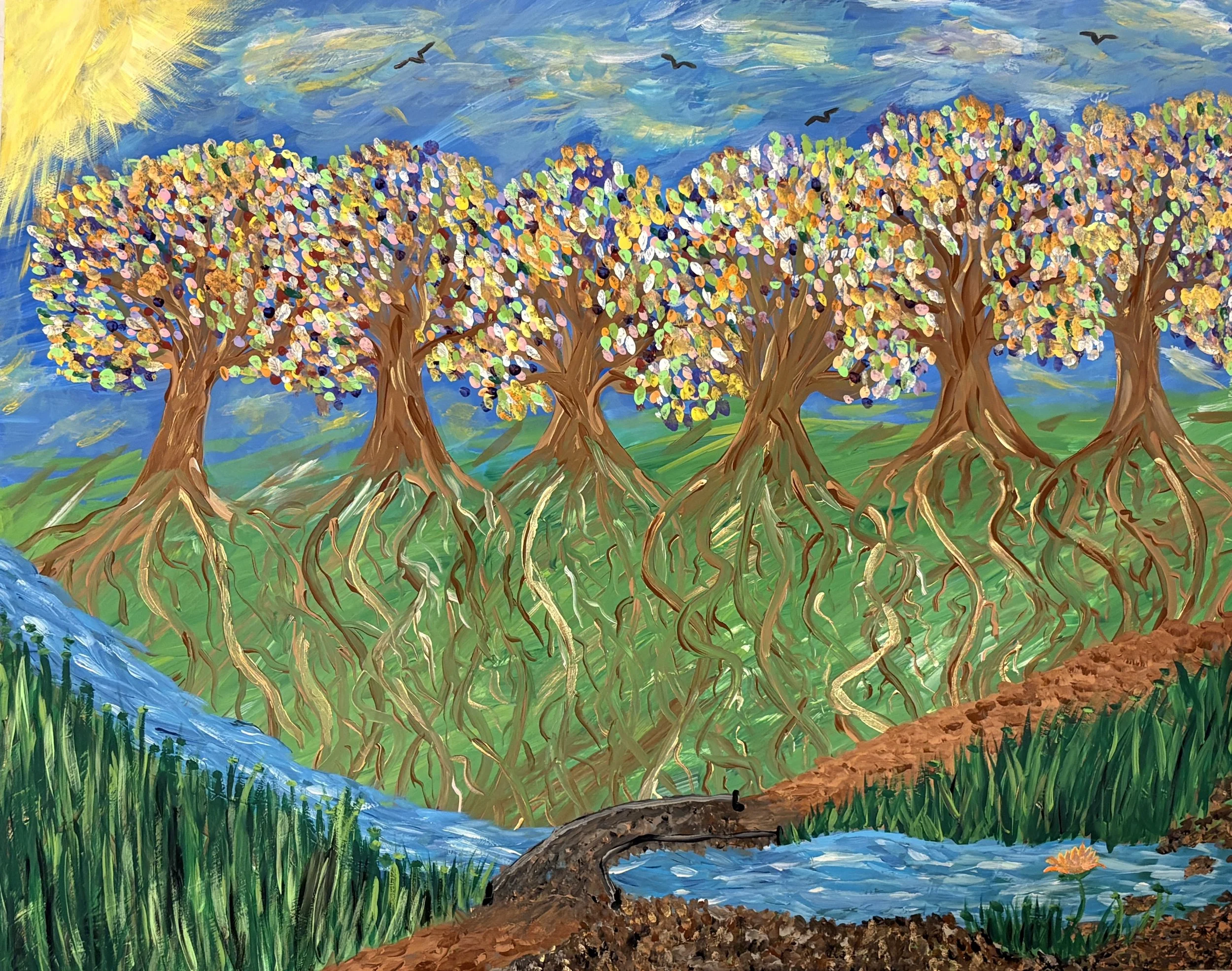
My most recent painting, inspired by James R. Eads’ Cosma Vision Oracle deck.
Gone, Now What?: Pilgrimage Two
My second pilgrimage experience is inextricably intertwined with my first. They are interwoven just as the fabric of family is often woven into each individual. So if a thread is pulled, the whole fabric can begin to unravel. My mother’s sudden death in 2021 began to unravel my family. I am my parents’ only child, and my mom and dad were married for nearly 50 years when my mom passed. The loss of my mom was something my dad could not move on from, no matter how hard he tried. He was diagnosed with PGD, MDD, and PTSD, and tried medication and therapy. His struggle to understand the meaning of his life without her in it was unattainable. As one of his only living family members, it was complicated and often a mess to try to support him through these years following her death.
In May 2025, he died of colon cancer. While both my parent’s deaths were quite sudden, with a matter of weeks between their diagnosis and passing, I can see now they both were ready to go when they did. This understanding of the timing of their deaths came from the second pilgrimage I took about two weeks after my dad’s death. I felt an intuitive pull to drive my dad’s car and a trailer carrying some of his most prized possessions back up to Washington. I decided on a similar route as my first solo pilgrimage through the Southwest. The energy of this trip was very different from my first pilgrimage in my mom’s car.
While the physical goals of transporting my parents’ vehicles and possessions from their home to mine had overlap, my mental, spiritual, and emotional state during this second pilgrimage was greatly depleted and raw with fresh grief and trauma of end-of-life care. Part of me wanted to hit i5 and drive home as fast as I could. But Sedona called, so I answered reluctantly, whether I was physically, mentally, and emotionally able or not. I set out driving, planning to spend two nights in Sedona before heading home to Washington. I felt drawn to stay in a different area of Sedona than my last time.
By Divine guidance, the Airbnb I ended up staying in was a few minutes' walk from The Amitabha Stupa and Peace Park, where there is a 36-ft Buddhist stupa, walking paths, Buddhist prayer wheels, and a Native American medicine wheel. Much like my first visit to Sedona, as soon as I drove over the hill entering the town, I could feel the energetic shift. I felt held and guided intuitively more than anywhere else I have ever been. During my time there, I rode my dad’s e-bike to the Chapel of the Holy Cross, where I had visited three years earlier. This time, I brought my mom physically with me and spread some of her ashes there. Knowing that a piece of my mom’s physical being would always live on that land meant so much to me.
I also spent most of my second day at the Amitabha Stupa and Peace Park. Walking around the Stupa, the paths, sending prayers of peace and healing with the prayer wheels, and walking the Indigenous people’s medicine wheel while spreading some of my mom’s ashes here were all deeply impactful. Up until my dad’s death, he had wanted my mom’s ashes to remain sealed with him. I respected his wishes, but being able to begin spreading her ashes at the sacred sites in such a spiritual place was another pivotal moment in the evolution of my grief process for my mother. I felt I was freeing her human form and giving her the adventures with me she had craved at the end of her physical life.
Leaving Sedona a second time, three years later, with both of my parents having transitioned from the physical world, I could feel a shift. I’ve heard the saying that home is a feeling that can be attributed to people, places, and things. During my pilgrimages through Sedona and the Southwest, I have experienced a sense of returning home, even though I have never physically lived there in this form. The drive home from Sedona to Washington this second time taught me again that I am more powerful and capable than I realized. Though importantly, this second trip also taught me the value of asking for help and how much more ease can come into my life when I release hyper-independence.
The Physical Body of Nature
From my first solo, Southwest, parental grief pilgrimage, I brought home with me my mom’s car. One of the purposes of this journey was to transport my mom’s car from California to Washington. But oh, how I learned this journey was about so much more. This car felt like an important part of my mom to receive. She bought this Honda Accord new in 2005. I grew up getting driven to dance lessons and school in her car. I learned to drive in her car. It was a staple of my childhood.
Then, nearly 20 years later, I would drive it nearly 1,400 miles back to my home in Washington, where my kids and I would drive it. It feels a bit strange to be attached to a physical object like a car in this way, but I feel connected with my mom when I am in her car. There’s a piece of her energy that lives on through it. There was a moment during the first Southwest road trip when I lost cell service and radio signal in the car, so I decided to see if there were any CDs in the player. When I pushed the play button on the CD player, the Honda’s speakers began playing Adele, Michael Bublé, Christian Rock praise-and-worship bands, and one of her best friends’ CDs. It brought me to tears. Not because it was my favorite music, but because it was hers. In that moment, I felt transported to the early 2000s, singing in the car with her on the way to school, and simultaneously back in the present moment, able to feel her sitting next to me on the road trip, saying, “Okay, it’s my turn to pick what we listen to, B.”
From my second solo, Southwest parental grief pilgrimage, I brought back some of my mom’s ashes. As I shared, I wanted to spread some in the sacred places in Sedona, but I also wanted to bring a physical piece of her with me for support on that trip. While the second drive through Sedona was beautiful and spiritually so important, I was much more actively in crisis and grief from the end-of-life process with my dad than I was on my first journey through. Having her physical ashes with me as I waded into the waters of compounded grief of my dad’s death was comforting. I foresee a journey back to Sedona again to connect with the deep home of spiritual nourishment I experience there.
A few months after this second journey, I returned to my parents’ home in California one final time to clear it out and put it up for sale. This time, I made the journey with my mother-in-law to support me in the packing process and transporting my parents’ possessions and ashes back to my home. Learning to accept help and support from others has been a journey in itself. A spiritual journey of sorts, filled with lessons about how letting others in is a Divine gift that can reap so many benefits in relational closeness if I let it. I have since spread most of the remaining ashes of my mom and dad in Long Beach, Washington, at a special cove we spent many happy days at the beach together. But I have saved a bit of both their ashes to spread on future pilgrimages, so I can share a bit of their physical being with the body of nature as I continue my journey of life.
Dying to Heal
As I reflect on both of my parental grief pilgrimages, I can see the similarities and differences in how the journeys cracked me wide open to heal. The first journey opened my eyes to how deeply connected my mental well-being is to my spiritual health. I learned that when I am far away from nature, I stagnate and dwindle mentally, physically, and spiritually. The pain of the second trip was more palpable and fresh, but consequently resulted in a faster integration of all I had learned and healed during that trip. With the second journey, I learned how varied grief can be. How the tidal waves of hypervigilance eventually wear down, and the raw wounds of loss are left exposed. This knowledge was quickly integrated into my being, like the burning away of the old confines of a limited life.
Both journeys intertwined to teach me that I am an unescapably spiritual being who needs to be spiritually free to express myself. With the knowledge gained from my first pilgrimage, I knew better how to commune with my parents on the other side on this second journey. The experience of my parents’ dying and the physical, emotional, and spiritual pilgrimages I have taken in the wake of their death have taught me many things. But most centrally, the lesson is that our ancestors are all around us, desiring to stay connected; if we tune in to the station, they will find us. Some things I don’t need a peer-reviewed study or two to prove the validity of existence. This is one of them.
My career path to become a mental health counselor has been deeply shaped by my parents’ death. Since my mom’s death, I have been fascinated by understanding end-of-life care and death work. Her death and my first pilgrimage through the Southwest were a major catalyst for beginning graduate school for Clinical Mental Health Counseling in 2024. I learned things about myself on both journeys that changed the trajectory of my path, aligning it with Divine guidance. Specializing in bereavement and end-of-life mental health care as I move into the next chapter of my journey as a counselor, feels like a calling I must answer. I view my existence in this space and time as being driven by learning and exploration. I am a constantly evolving student of life, striving to grow and learn how to support others in mind, body, and spirit. Each journey I am guided to teaches me something new and important.
If you made it this far, I appreciate the time and energy you took to engage with this piece. May you find gentleness in holding space for your physical, spiritual, mental, emotional, and relational pilgrimages through the liminal spaces of life.
With gratitude and love,
Erica